01 · ASSIGN
Choose your project folder
Start with the ordinary folder that already holds your research data. No migration and no upload.
SepiaLog is a private, local research data journal. Connect the folder you already use and write one short note after each meaningful change. SepiaLog links that note to the exact data version, so useful documentation grows while you work.
SepiaLog does not ask you to redesign your workflow. It adds one small action at the moment when the reason is still fresh.
Start with the ordinary folder that already holds your research data. No migration and no upload.
After a meaningful change, leave one short message. A clear sentence is enough.
The note, affected file and data state become one point on your research timeline.
See the decision and reopen the folder as it was when that decision was made.
SepiaLog supports the everyday work behind a dissertation, a paper, a team review, or a reliable archive package.
A sentence today can answer a difficult question in year three. Know which file produced the result and why observations were removed.
Review decisions since the last meeting and connect a paper to the exact dataset version behind it.
Help teams build FAIR documentation and stronger archive packages without sending sensitive data to a cloud service.
SepiaLog works locally, requires no account, and does not depend on cloud storage for your research data.
The value is not the note itself. It is what the accumulated record makes possible when a paper, handover or archive deadline arrives.
Recover the dataset state and reasoning behind a result without relying on filenames or memory.
Turn the most boring part of research data management into a small, repeatable action.
Give your future self, supervisor or collaborator a record that explains both the data and the decisions.
Use Quick Log without leaving the file you are working in. Later, Timeline brings the note and exact version back together.
Watch the videos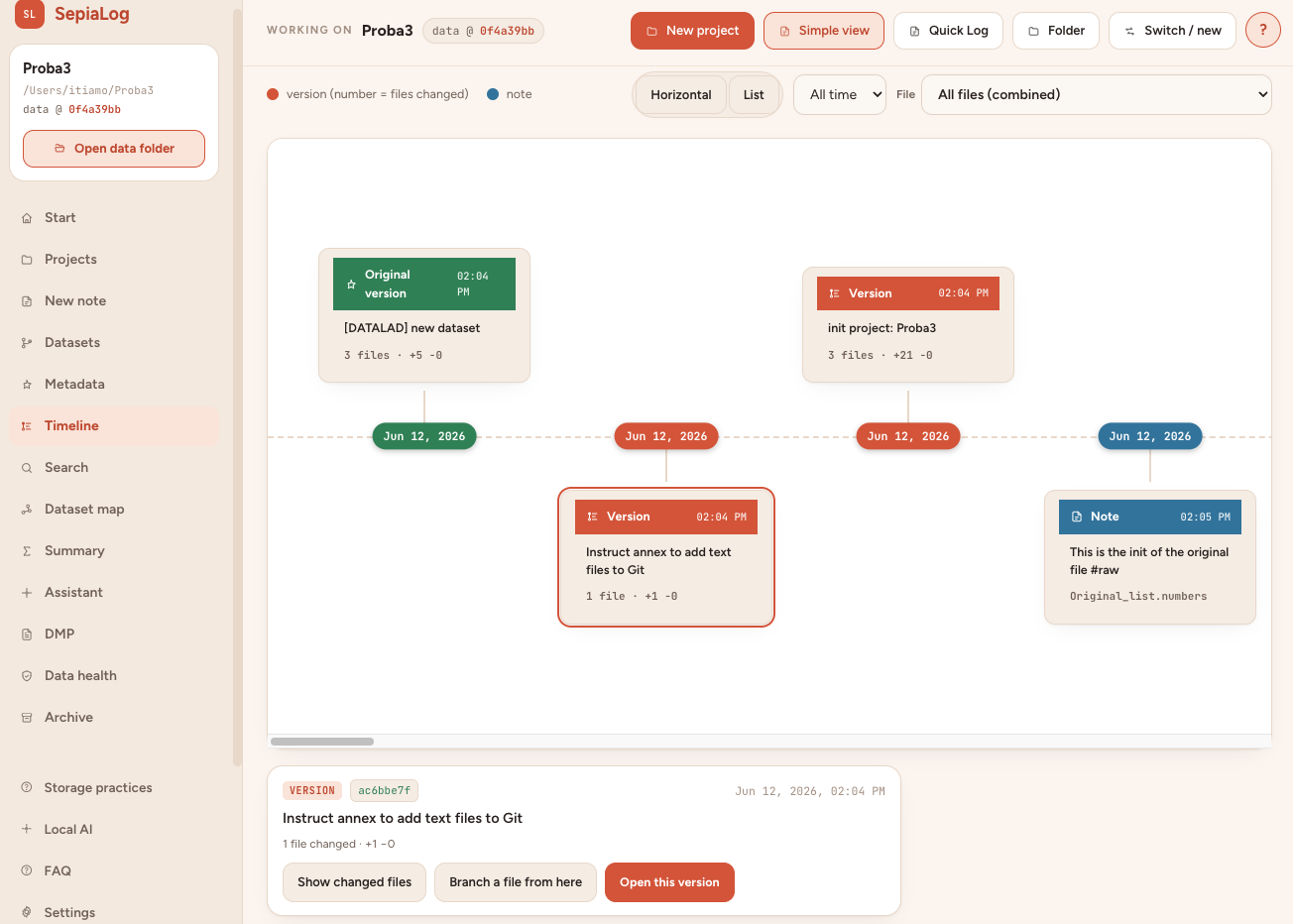
SepiaLog does not replace Git. It helps researchers record decisions in ordinary folders and turn that growing record into something useful later.
SepiaLog includes version history and can also work with Git or DataLad for advanced workflows.
“Researchers do not need another complicated system. They need a small habit that makes the boring documentation work pay off later.”
Connect its folder and record one meaningful change today. That is enough to start building the record your future work will need.